
The availability of oxygen is critical for supporting human life. Oxygen deficiency is a condition in which the oxygen supply is insufficient to support normal biological or physiological function. The U.S. Occupational Safety and Health Administration (OSHA) defines an oxygen-deficient atmosphere as one containing less than 19.5% oxygen by volume.
Oxygen levels below 19.5% lead to hypoxia and are considered immediately dangerous to life or health, with effects varying with the available oxygen concentration.
- At levels between 16% and 19.5%, workers may experience increased heart rate, accelerated breathing, impaired thinking, and diminished coordination.
- Levels between 10% to 12% typically result in rapid breathing, impaired judgment, and blue lips.
- Levels below 10% may lead to fainting, unconsciousness, and death.
Companies across many industries perform oxygen level monitoring to safeguard workers against the negative health effects of deficiency. The AMI Model 221R is an advanced oxygen-deficiency monitor that provides organizations with a valuable tool to support oxygen-deficiency safety, protect workers, and ensure compliance with industry regulations. The monitor delivers precise oxygen level readings necessary to avoid oxygen deficiency and excessive oxygen enrichment, both of which can be damaging or dangerous in industrial settings.
Why Oxygen Deficiency is a Serious Hazard
Oxygen deficiency in industrial processes often results from the displacement of oxygen by other gases entering a space, reducing the oxygen concentration. The other gases displace oxygen and occupy volume in enclosed spaces. The pressure typically remains constant, but the fraction of oxygen in the atmosphere decreases, resulting in oxygen-deficient environments.
Common gases associated with oxygen displacement are:
- Nitrogen (N₂)
- Argon (Ar)
- Helium (He)
- Methane (CH₄)
- Carbon dioxide (CO₂)
Teams must monitor for oxygen deficiency to avoid the health effects of oxygen-deficient environments on personnel. Humans subjected to oxygen levels below 19.5% experience multiple effects, including an increased breathing rate, impaired judgment, and blue lips. When levels drop below 10%, workers can faint, become unconscious, and die from lack of oxygen.
Some commonly used industrial gases that can displace oxygen, such as nitrogen and argon, are both colorless and odorless, making them more difficult to detect. The difficulty in detection can turn a leak into a very serious, unseen hazard that can jeopardize employee safety.
Asphyxiation prevention is essential to protect personnel from the effects of oxygen displacement. For example, afterdamp is a suffocating mixture of nitrogen and carbon dioxide that displaces oxygen in mines after a methane explosion or a coal-dust fire. Afterdamp often causes more deaths than the initial explosion. Teams must test for oxygen levels to perform rescue and recovery activities safely.
Companies are required to implement a combustion oxygen-deficiency solution to support oxygen-reduction or inert-gas fire-suppression systems. Fire oxygen-deficiency monitoring is necessary to maintain oxygen levels between 14% and 15% to prevent combustion and protect workers. Monitoring ensures oxygen levels remain within safe limits and triggers alarms or ventilation systems if they are too low.
Oxygen enrichment also poses a safety hazard in certain industrial settings where it is used to enhance efficiency. An increase in the oxygen concentration in an atmosphere or gas mixture above the normal level of approximately 21% presents a substantially higher risk of fire or explosion. Excessive oxygen causes flammable materials to ignite more easily and burn more vigorously. Oxygen level monitoring is essential to enable teams to use enrichment processes safely and effectively.
How Inert Gases Are Used in Industry
Argon, helium, and nitrogen are widely used as inert gases across multiple industrial processes. Their primary function is to create controlled oxygen-free or non-reactive environments that prevent combustion, oxidation, and contamination. Inerting and blanketing with these gases are critical in aircraft fuel systems, petrochemical and pharmaceutical storage tanks, food packaging, and semiconductor manufacturing. Nitrogen is the most common gas used for cooling, although helium is also used based on the specific application.

The following examples illustrate some of the ways industries use inert gases for crucial processes and activities.
- The food industry uses nitrogen for flash freezing and carbon dioxide or nitrogen for food preservation and packaging.
- Beer production uses CO₂ for natural fermentation.
- The aircraft, petrochemical, and pharmaceutical industries use nitrogen or argon for oxygen displacement to prevent reactions during tank blanketing and inerting applications.
- Welding and metal fabrication processes use inert gas shielding with argon and helium to prevent oxidation that weakens welds.
- The medical industry cools MRI machines with helium, uses argon in surgical procedures, and nitrogen for the cryopreservation of biological samples.
- Laboratories will commonly use nitrogen for creating controlled inert or anaerobic environments for research and product storage
- Additive Manufacturing or 3D printing will use an inert gas such as argon as a shield gas to prevent oxidation and contamination of metal powders during storage and sintering.
- Inert gases are vital in the oil and gas industry for removing oxygen and reducing the risk of explosions during pipeline purging and tank inerting.
- Manufacturers in electronics and semiconductor processing use high-purity nitrogen and argon to maintain pristine environments and prevent oxidation and contamination.
Industries Affected by Oxygen Deficiency Addressed by Model 221R
Many industries that use inert gases must monitor for oxygen deficiency to ensure worker safety. These industries typically share three characteristics that make oxygen deficiency monitoring essential.
They use inert gases that can displace oxygen.
Activities are conducted in confined and possibly poorly ventilated spaces.
Manufacturing tasks may expose workers to the unseen hazard of oxygen deficiency.
The following examples demonstrate the importance of deploying reliable solutions, such as the Model 221R, to monitor oxygen levels.
High Tech & Electronics Manufacturing
High-tech and electronics manufacturers rely on purging operations and maintaining an inert atmosphere to prevent dangerous chemical reactions. Specific processes where oxygen deficiency monitoring is essential include:
- Providing a stable atmosphere for 3D printing to control the behavior of reactive powders;
- Semiconductor manufacturing to provide inert conditions for wafer processing;
- OLED/LED display manufacturing to prevent oxidation of sensitive organic and thin-film materials;
- Battery production requires cell assembly in dry, oxygen-free environments.
Monitoring enables teams to control oxygen levels, ensuring safety.
Chemical & Petrochemical Industry
The chemical and petrochemical industries must monitor oxygen deficiency in multiple processes. Typical applications in which the continuous use of nitrogen or argon can displace oxygen include tank purging, fertilizer production, gas production using air separation units, and maintaining refinery safety. Teams must deploy oxygen deficiency monitoring to protect themselves from risks such as faulty purging operations, inert gas leaks, and cryogenic expansion.
Oil & Gas
Businesses in the oil and gas industry must maintain safe oxygen levels in confined spaces on offshore rigs, pipelines, and compressor stations. Monitoring solutions must be deployed to prevent oxygen deficiency and protect worker safety. Oxygen deficiency can occur during purging operations and when using nitrogen in fire-suppression equipment. Ventilation failures and leaks can quickly render an environment unsafe due to a lack of oxygen.
Food & Beverage
In the food industry, companies monitor oxygen levels in grain silos, fermentation tanks, and freeze tunnels. Monitoring is also required during the Modified Atmosphere Packaging (MAP) process for meat packaging. Food freezing processes must minimize or eliminate oxygen to prevent freezer burn and maintain product quality. Industrial risks that require oxygen-deficiency monitoring include inert-gas displacement, purging operations, ventilation failures, and equipment leaks.
Pharmaceuticals & Laboratories
The pharmaceutical industry and research laboratories utilize cryogenic gases to create controlled environments in glove boxes or to create extremely cold environments. Monitoring is essential to reduce the risks of cryogenic expansion and maintain safe oxygen levels in labs. The risk of oxygen displacement from gas stored in dewars is high due to the use of liquified nitrogen, argon, carbon dioxide, helium, and other cryogenic gases in facilities.
Teams must also safeguard against oxygen deficiency during purging operations and minimize the risk of equipment leaks and ventilation failures with reliable monitoring solutions.
Aerospace & Aviation
The aerospace and aviation industries use inert gases for many applications, including inerting fuel tanks and hydraulic systems, manufacturing processes, and tire inflation. The use of inert gases raises safety concerns due to the potential for oxygen displacement. Worker safety can be affected by ventilation failures, equipment leaks, and inert-gas fire-suppression systems that displace oxygen, creating dangerous conditions.
Teams conducting aviation research must monitor for oxygen deficiency during ground testing and in spacecraft vacuum-oxygen simulations. These tests demand precise monitoring to ensure the safety of pilots and astronauts.
Additive Manufacturing (3D Printing)
The metal powders used in additive manufacturing processes can be sensitive to oxidation when exposed to the normal atmosphere in storage, transport, or processing. An inert gas such as argon is used to protect the product from oxidation or other contamination. This can include completely displacing the printing chamber of any oxygen with argon to shield the process during fabrication. If the gas is not properly containted in the within the storage or 3D printing system, it can displace the oxygen in the work area, creating an oxygen-deficient environment.
Welding & Metal Fabrication
Inert gas shielding with argon, helium, and nitrogen is used in welding and metal fabrication to protect molten metal from oxygen and other reactive gases, preventing oxidation and minimizing porosity and contamination. Heat treatment and annealing furnaces require oxygen-free environments for clean, high-quality surfaces. Powder metallurgy processes must prevent oxidation during sintering and atomization.
Manufacturers must maintain strict control of the welding atmosphere to ensure weld protection and efficient production. Welders often work in confined spaces and must monitor the environment for oxygen deficiency to protect their health from inert gas displacement, localized gas accumulation, ventilation failures, and equipment leaks.
Maritime & Shipbuilding
The maritime and shipbuilding industries must ensure safe conditions in cargo holds, ballast tanks, and enclosed compartments. The maritime industry requires oxygen-deficiency monitoring to ensure safe entry into enclosed spaces and protect crew members. Risks to personnel in these industries include oxygen displacement from equipment leaks, fire-suppression systems, and ventilation failures.
Mining & Underground Work
Companies in the mining industry and other industries involving underground work, by definition, operate in confined spaces where oxygen deprivation can be disastrous for the workforce. Typical applications in the industry include mine construction, resource extraction, and transportation. These activities can result in afterdamp and methane displacement, creating dangerous conditions in poorly ventilated areas. Other risks to workers include ventilation failures, equipment leaks, and oxygen displacement from fire-suppression solutions.
General Confined Spaces
Confined and enclosed spaces, such as sewers, manholes, tunnels, storage tanks, and underground vaults, pose safety risks to workers. Equipment leaks, displacement, ventilation failures, and inert-gas fire suppression can deplete oxygen levels. Deploying oxygen-deficiency monitoring is essential to protect workers in these environments.
Why Choose the AMI Model 221R
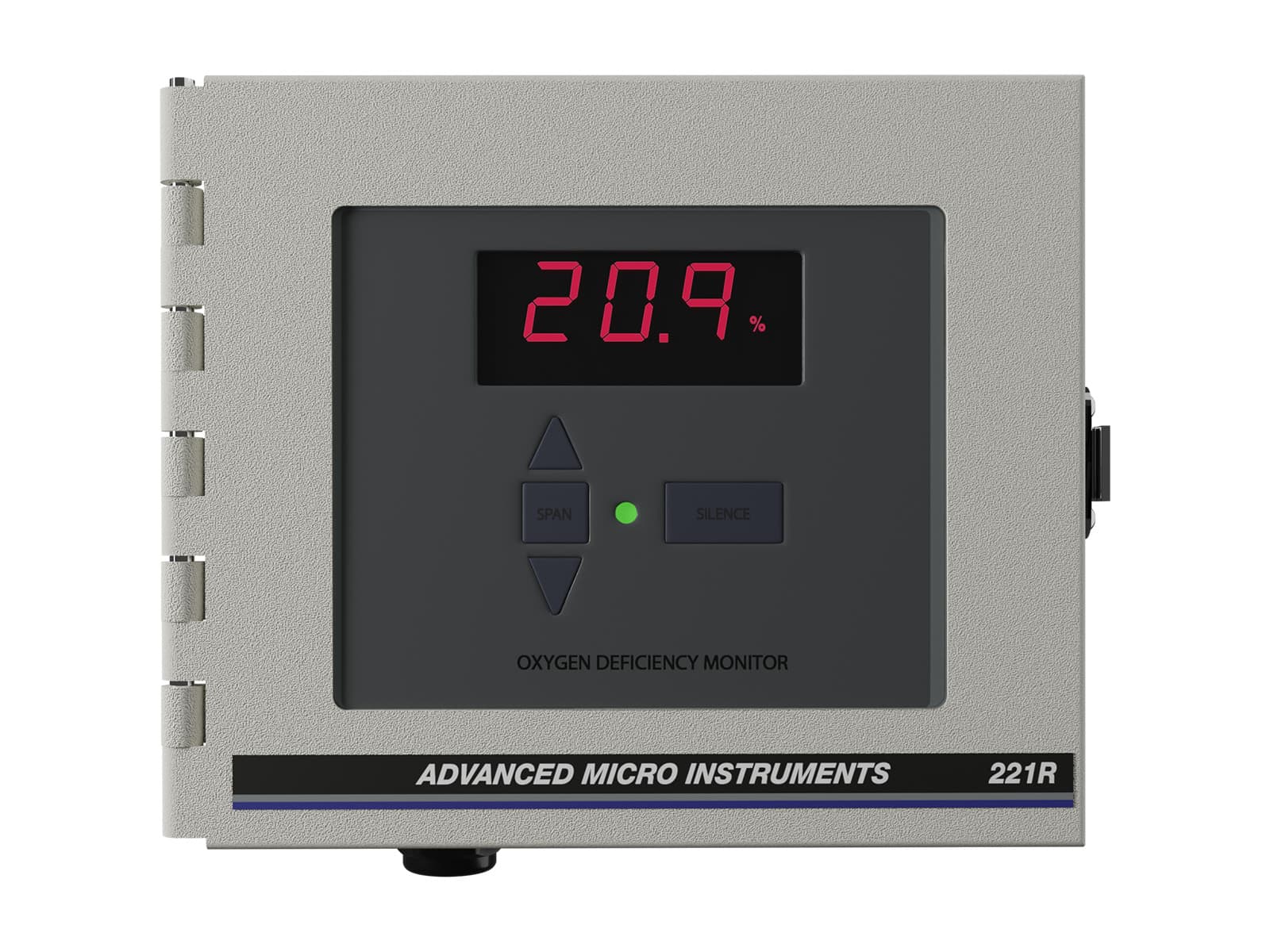
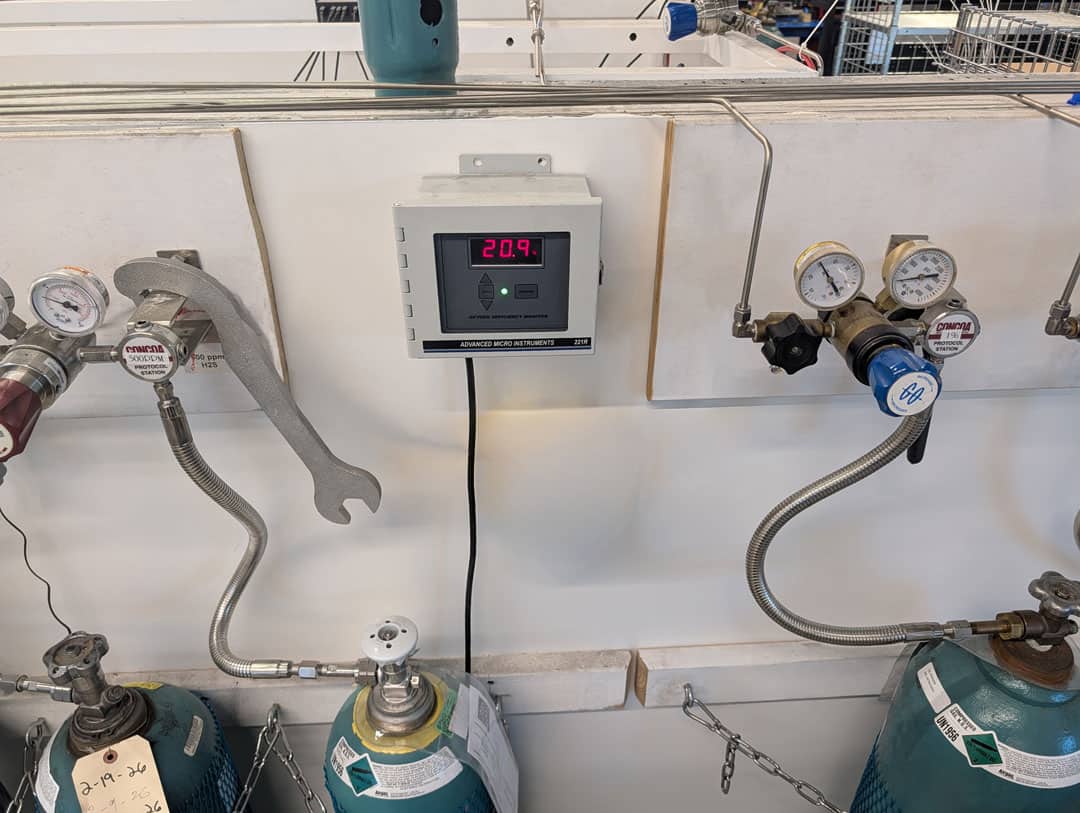
The AMI Model 221R is a wall-mounted oxygen-deficiency monitor designed to continuously monitor oxygen levels in high-risk industries. The unit’s powder-coated aluminum enclosure and rugged design protect against dust and water ingress from low-pressure spray. The design supports maintenance with a low-pressure washdown of the monitor in challenging industrial environments.
This advanced oxygen level analyzer offers many features that make it an excellent solution for companies concerned with oxygen-deficiency safety. Companies deploying the monitor enjoy the following benefits from the Model 221R.
The Model 221R delivers precise oxygen level readings with zirconium oxide sensors over a wide temperature range (0-130°F) and is unaffected by changes in barometric pressure. Three OSHA-standard preset alarms provide oxygen-deficiency and enrichment information vital to worker safety.
- Oxygen readings below the 19.5% danger level trigger a red warning light, a 95 dB audible alarm, and de-energize relays 1 and 2.
- Oxygen readings below the 20.0% caution level trigger a yellow caution light and de-energize relay 1.
- Oxygen readings above the 23.5% enrichment level trigger a red warning light, a 95 dB audible alarm, and de-energize relays 1 and 2.
Additional features of the Model 221R include:
- Easy access to controls with a latched, hinged, and lockable protective door;
- Optional remote monitoring with a range of up to 300 feet;
- A three-digit LCD reading the full scale from 0.0% to 25.0%;
- 10-year sensor life with minimal, periodic calibration;
- 4-20 mA isolated analog active output.
- Two alarm relay contacts that can activate devices such as remote strobe lights or ventilation fans
These features position the Model 221R as the logical choice for companies requiring reliable, precise monitoring of oxygen deficiency and enrichment.
Compliance and Safety Benefits
Companies operating in industries affected by oxygen deficiency must implement oxygen level monitoring solutions to comply with government and industry safety standards.
The following standards are enforced to promote oxygen-deficiency safety and asphyxiation prevention. They protect the viability of industrial processes and the health of the workforce.
- OSHA: This regulation defines oxygen deficiency as an atmosphere with oxygen concentration below 19.5% by volume. It is the general industry standard and applies to confined spaces and areas where gases are stored or used. Compliance requires atmospheric testing before entry and continuous monitoring in hazardous environments.
- NIOSH: The National Institute for Occupational Safety and Health also defines a deficiency as oxygen levels below 19.5% by volume. Lower concentrations establish immediately dangerous to life or health (IDLH) conditions and may rapidly impair workers' ability to function safely and effectively.
- ANSI: The American National Standards Institute’s regulations apply to confined spaces and define the same 19.5% threshold as a safe oxygen level. The regulations also define an oxygen-rich atmosphere as one containing more than 23.5% oxygen by volume, which increases the risk of fire.
- CGA: The Compressed Gas Association’s standards align with OSHA and NIOSH regulations. They are primarily used for monitoring gas levels in storage and handling areas.
All standards consider 19.5% to be the minimum safe oxygen level to support human activity. This threshold includes a safety margin, enabling corrective action to be taken before catastrophic effects are felt.
Oxygen level monitoring solutions, such as the Model 221R, are essential components of comprehensive oxygen-deficiency prevention protocols that may include the following elements.
- Companies should perform a hazard identification and risk assessment to inventory gases they use and store. They should identify tasks that may displace oxygen and spaces that are poorly ventilated. Teams should perform and document a Job Safety Analysis (JSA).
- Engineering controls form the primary defense against oxygen deficiency. Specific measures include ventilation, oxygen monitoring with alarms, process controls such as automatic shutoffs, and leak detection. Confined space entry controls, including pre-entry atmospheric testing, entry permit systems, and defined rescue plans, are essential to ensure worker safety.
- Companies need strict administrative controls, such as standard operating procedures, for activities like inerting, purging, and cylinder handling. Employees should be assigned permits for hazardous tasks, and businesses should restrict access to potentially dangerous areas to trained personnel.
- Employees may have personal protective equipment (PPE) available, including personal oxygen monitors with alarms and supplied-air respirators. Workers must be trained to recognize oxygen-deficiency hazards, the symptoms of hypoxia, and the proper operation of gas-monitoring equipment.
- Organizations should develop emergency response and rescue procedures. Evacuation should be initiated upon alarm activation to ensure safety. Gas detection and monitoring equipment should be calibrated according to the manufacturer’s guidelines, and periodic audits of alarm and ventilation systems should be conducted.
Why Oxygen Monitoring Matters
Oxygen-deficient environments pose extreme dangers to workers in many industries. Inert gases can displace oxygen and quickly create dangerous conditions that can potentially result in asphyxiation and death. Industrial and manufacturing processes performed in enclosed spaces can expose workers to an oxygen-deficient environment. Equipment failures may lead to unsafe oxygen levels that harm the workforce.
AMI’s Model 221R is a trusted solution for oxygen deficiency monitoring to ensure personnel safety. The device is the gold standard for oxygen deficiency and confined-space oxygen monitoring, used by thousands of organizations in government, academia, and diverse industries. It provides precise, stable readings and is unaffected by changes in barometric pressure. The unit is virtually maintenance-free with unique oxygen sensors that deliver a 10-year life expectancy.
Contact Advanced Micro Instruments to learn how the Model 221R Oxygen Deficiency Monitor can protect your workforce and ensure compliance with safety regulations.
Oxygen Deficiency Monitor Downloads
We also have an extensive literature library that provides customers with detailed information about gas production and our wide range of products.


